ChatGPT ads are becoming a new part of the digital advertising landscape. Instead of appearing beside traditional search results or between social media posts, they introduce paid visibility into an environment where people actively ask questions, compare products and explain what they are trying to achieve.
This matters because conversations with AI often contain much more detail than a conventional search query. A user may describe a problem, budget, preferred features and limitations before making any purchase decision. For advertisers, this creates an opportunity to reach potential customers during research and consideration, before demand is fully formed.
A New Type of Advertising Environment
ChatGPT advertising creates a different relationship between user intent and paid media. Traditional search campaigns usually begin with a keyword, while social campaigns often depend on audiences, behaviour and creative engagement.
An AI conversation can provide more context because users may continue asking questions and refining their needs over several messages. For marketers, the important question is therefore not only which terms people search for, but also which problems they describe before choosing a product, service or provider.
A short Google query might be “CRM software for small business”. An AI conversation can be much more detailed, including team size, budget, integrations and specific requirements. That additional context gives advertisers a clearer picture of the user’s intent.
Businesses should not treat this shift as a reason to abandon established channels. Search engines still capture high-intent demand, while social platforms remain strong for discovery and demand generation.
An experience PPC agency can help businesses evaluate where AI advertising fits alongside existing campaigns and whether it creates additional value rather than simply moving budget between platforms.
What Are Paid Placements in ChatGPT?
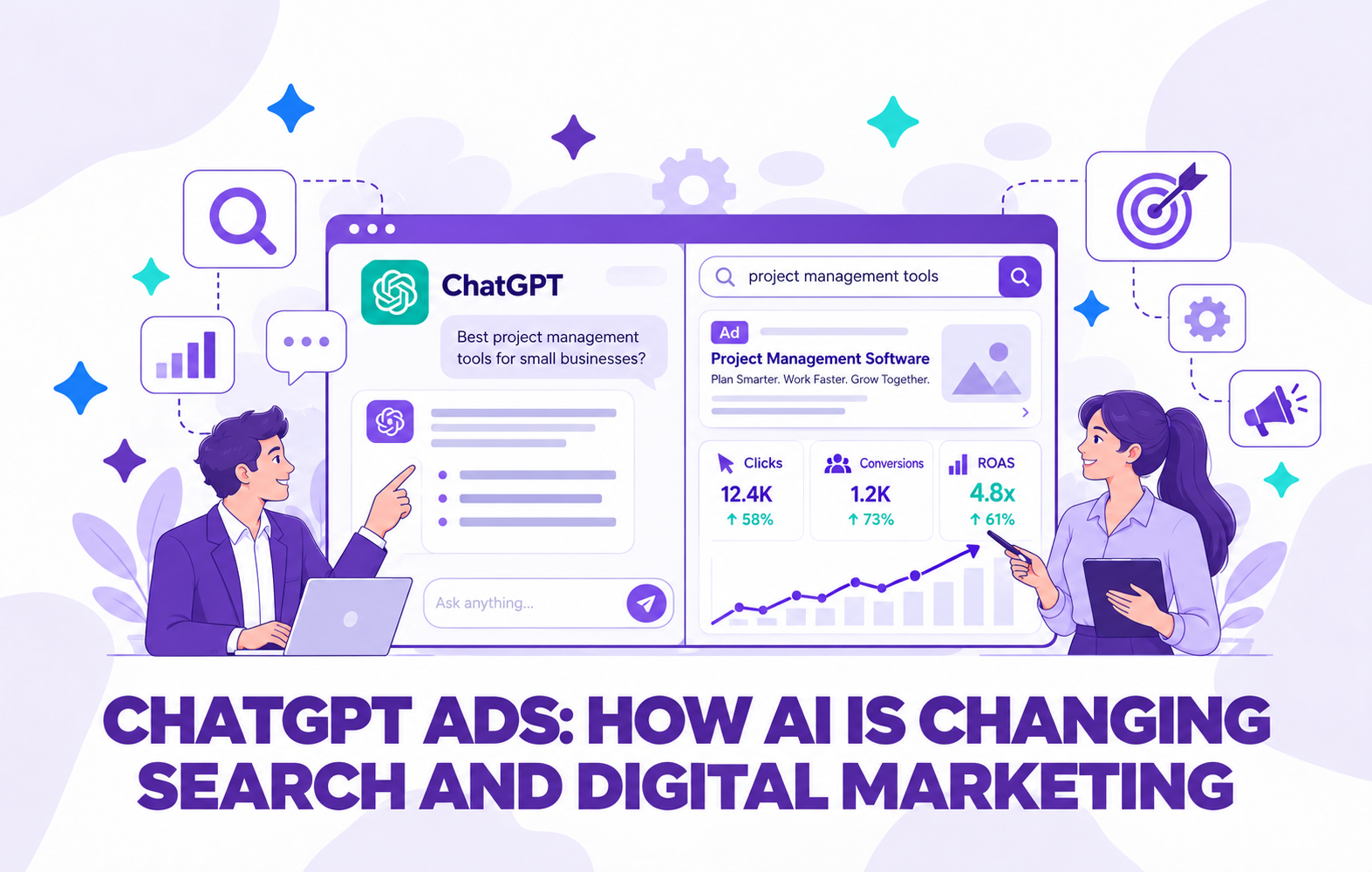
OpenAI has been developing an advertising model in which commercial placements remain separate from the assistant’s organic answers.
Ads are clearly identified as sponsored content, and advertisers do not gain the ability to influence the answers generated by ChatGPT.
A standard placement can include:
- advertiser name;
- headline;
- description;
- destination URL;
- brand identity;
- visual creative.
The surrounding environment is different from a traditional display placement because the user may already be discussing a specific problem or comparing several possible solutions.
This makes ads in ChatGPT potentially more contextual than conventional display advertising. Instead of relying on broad promotional claims, advertisers can use clearer messages that explain what the product does, who it is for and why it may be relevant.
How Does OpenAI’s Advertising System Work?
OpenAI has been expanding the tools available to advertisers, including CPC bidding and a beta self-service Ads Manager.
Advertisers can create campaigns, manage budgets, upload creative and monitor performance. For click-oriented campaigns, maximum CPC bids can be set at ad-group level.
The auction considers advertiser value as well as the relevance and usefulness of the ad. This means the highest bid alone may not be enough if the message does not fit the context.
That is one reason why advertising on ChatGPT may require a different creative approach from conventional paid search. Clear, specific and benefit-focused messages are likely to be more useful than generic slogans.
For example:
“The Best Solution for Your Business”
provides little information.
A message such as:
“Payroll software for international teams with automated compliance reporting”
immediately explains the product, audience and benefit.
ChatGPT Ads vs Google Ads
Google Ads and AI advertising should not automatically be viewed as competitors.
Google Search is particularly powerful when users already know what they want. Queries such as “payroll software UK” or “buy running shoes online” show relatively clear intent.
AI assistants can play a role earlier in the process, when a user is still comparing options or trying to understand which solution is appropriate.
This means Google can remain effective for capturing existing demand while AI platforms may increasingly influence how that demand is formed.
For businesses, the key question is whether a new channel creates incremental value: more qualified users, better customer acquisition or additional reach at a useful stage of the customer journey.
Measurement and Conversion Tracking
A new advertising platform is difficult to evaluate without reliable measurement.
OpenAI’s Ads Manager provides metrics such as:
- impressions;
- clicks;
- CTR;
- CPC;
- spend;
- conversions.
Advertisers can also use tracking parameters such as UTMs to analyse traffic in external analytics platforms.
OpenAI is developing broader measurement infrastructure, including Pixel, Conversions API, attribution solutions, incrementality measurement and brand measurement.
For performance marketers, clicks alone are not enough. Businesses should also analyse conversion rate, cost per qualified lead, customer acquisition cost, revenue and lead quality.
How AI Fits Into a Wider Marketing Strategy
AI advertising should be analysed as part of the full acquisition mix.
A customer may discover a product through Meta, use an AI assistant to compare options, search for a preferred brand on Google and later return through remarketing.
For a digital marketing agency, the challenge is therefore not simply to maximise performance inside one advertising platform. It is to understand how search, social, AI discovery and remarketing contribute to the same customer journey.
Which Businesses Could Benefit Most?
The strongest opportunities may appear in categories where customers typically research before purchasing.
Examples include:
- B2B software;
- professional services;
- financial products;
- technology;
- education;
- travel;
- complex e-commerce products.
In these categories, users often compare features, pricing, providers and alternatives before making a decision.
That makes conversational AI particularly relevant during the research stage.
Should Businesses Start Testing Now?
Businesses do not need to move large budgets away from established campaigns simply because a new advertising platform becomes available.
A controlled testing approach is more sensible.
Before launching, companies should:
- identify products with strong research or comparison intent;
- analyse common questions customers ask before buying;
- create several distinct advertising messages;
- ensure landing pages match each offer;
- implement reliable conversion tracking;
- use dedicated UTMs;
- compare results with existing acquisition channels;
- scale only when the economics make sense.
Will AI Ads Replace Google or Meta?
That is unlikely in the near term.
Google remains strong for high-intent search, while Meta is powerful for visual discovery and audience-based advertising.
AI assistants add another environment rather than replacing those platforms.
The most effective strategy is likely to combine channels based on the role each one plays in the customer journey.
The Future of AI Advertising
The significance of advertising inside AI assistants is larger than one new ad platform.
Search advertising grew as users moved product research into search engines. Social advertising became essential as discovery shifted toward feeds and creator-driven platforms. AI assistants now create another environment where people can compare products, explore options and make decisions.
The challenge for marketers is not to chase every new platform, but to understand where it can generate measurable value.
If you are already investing in paid search or social advertising, now is the right time to evaluate where AI-driven advertising could fit into your acquisition strategy. Start with controlled tests, clear tracking and realistic performance benchmarks. The businesses that learn how this channel works early will be better positioned to scale it when conversational advertising becomes more mature.