Digital acquisition is no longer a simple choice between SEO, paid search and social ads. Brands increasingly work with affiliates, external traffic teams, creators and ad networks at the same time. Media buying sits at the centre of many of these activities, but it is often confused with affiliate marketing and performance marketing. The three overlap, yet they describe different parts of the acquisition process: who funds traffic, who controls campaigns, how partners are paid and where the commercial risk sits.
Affiliate marketing is primarily a partnership model. An external partner promotes a product or service and receives compensation when an agreed action takes place, such as a purchase, lead, registration or first deposit. Performance marketing is broader: it describes marketing activity managed around measurable business outcomes. Paid acquisition is the operational layer where advertising budget is turned into traffic and conversions.
The difference matters because two campaigns can generate the same result while using very different financial and operational models.
What Is Affiliate Marketing?
In affiliate marketing, the advertiser and partner agree on the commercial terms, tracking and the event that triggers payment. The advertiser may not control exactly how the partner generates traffic, while the affiliate may carry part of the acquisition risk before a conversion happens.
This can make affiliate partnerships attractive, but they are not automatically low-risk. Businesses still need reliable attribution, fraud controls, clear rules and an understanding of customer quality. A source that generates inexpensive registrations but poor retention can look efficient in a report while creating little long-term value.
From the perspective of a digital marketing agency, affiliate activity should therefore be evaluated alongside paid search, paid social, SEO, conversion performance and customer economics rather than treated as an isolated channel.
Affiliate Marketing Is More Than Affiliate Links
Affiliate marketing is no longer limited to publishers placing links in articles. Affiliates can run comparison platforms, communities, email audiences and complete paid acquisition operations with dedicated creative, analytics and optimisation teams.
When paid channels are part of the acquisition mix, a clear paid media strategy helps define which traffic sources to use, how budgets should be allocated, how performance will be measured and what level of transparency is required. For businesses working with external partners, this also means setting clear rules around attribution, conversion quality and the role paid traffic plays within the wider acquisition model.
For affiliates, the challenge works in the opposite direction. They need an offer that converts, reliable tracking and enough margin between traffic costs and commission revenue to remain profitable. That makes commercial discipline just as important as traffic volume.
Where Paid Traffic Fits Into Affiliate Marketing
An affiliate can generate users organically, through an existing audience or by buying traffic. Once paid traffic is involved, the affiliate may operate much like an independent advertising team: choosing sources, producing creatives, testing landing pages, monitoring conversion rates and deciding where additional budgets should go.
The advertiser may only see the final conversion and commission. Behind that result, however, there can be a sophisticated acquisition operation making many of the same decisions as an internal performance team.
This is where practical experience becomes especially important. Platforms, tracking requirements and traffic costs change quickly, and an approach that works in one market may fail in another. Advantage Agency follows a broader model that combines a media buying team, an education platform and an ecosystem for media buying, connecting campaign execution with continuous learning and testing.
“Strong media buying is not just about launching campaigns. It requires the right team, a clear testing process and an environment where knowledge from real campaigns can be shared and applied quickly.”
– Marko, Head of Operations & Strategy, Advantage Agency
What Is Performance Marketing?
Performance marketing is broader than affiliate marketing. It can include paid search, paid social, affiliate partnerships and other channels, as long as activity is measured and optimised against defined outcomes such as revenue, leads, purchases, installs or subscriptions.
A performance marketing strategy looks across these channels and asks where investment is producing the strongest return. The budget can then move between campaigns, audiences, markets and messages based on performance data.
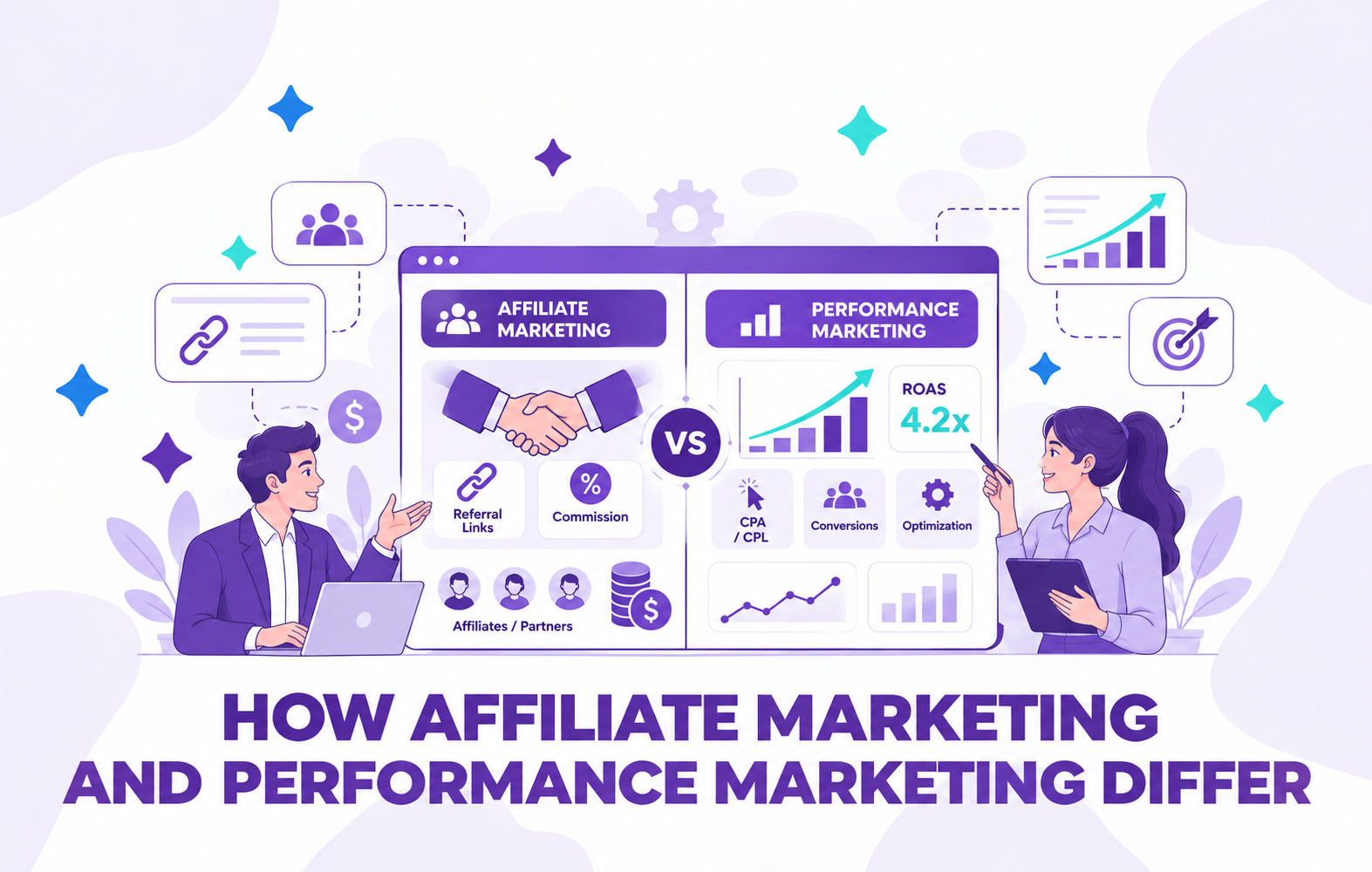
The key difference is ownership. In a traditional affiliate arrangement, the partner may control traffic generation and carry much of the initial advertising risk. In a company-run performance campaign, the advertiser usually funds traffic directly and owns the account, campaign data and optimisation process.
Neither structure is automatically better. The right choice depends on resources, expertise, risk tolerance and how much control the business wants over acquisition.
Affiliate Marketing vs Performance Marketing
The simplest distinction is this: affiliate marketing mainly describes a relationship and payment model, while performance marketing describes how marketing investment is managed.
A company can work with a PPC agency that manages Google Ads while the advertiser pays the platform directly. The agency may optimize campaigns around revenue, leads or ROAS, making the activity performance-focused, but it is not an affiliate relationship unless the commercial agreement is structured that way.
By contrast, an affiliate may buy traffic independently and receive a fixed CPA or revenue share only after generating the agreed result. In both cases the user can arrive through paid advertising, but the financial relationship behind that acquisition is different.
Risk, Control and Data
When a company buys advertising directly, it usually carries the traffic risk. If the campaign does not convert, the advertising platform is still paid. An affiliate using paid acquisition may carry that initial risk instead and receive compensation only when conversions occur.
That difference affects pricing. Affiliates need enough margin to cover unsuccessful tests, creative production, technology and team costs. Advertisers need a commission structure that attracts capable partners without damaging unit economics.
Control is another consideration. Direct campaigns usually provide more visibility into keywords, audiences, creatives, search terms and geographic performance. Affiliate activity can be less transparent, depending on the relationship and reporting setup.
This does not make affiliate traffic worse. It simply means businesses should define how much transparency they need and which data partners must provide.
Where Paid Acquisition Becomes a Strategy
Choosing an advertising platform is only the start. Teams need to understand how much they can afford to pay for a customer, which conversion event should guide optimisation and how much evidence is required before scaling.
A strong media buying strategy connects these decisions. It defines which markets and platforms to test, how budgets are allocated, which creative hypotheses matter, what tracking is required and which metrics determine whether a campaign should be scaled, changed or stopped.
A practical media buying strategy should include:
- Clear audience and market priorities
- The right advertising platforms
- Defined budgets and performance targets
- Reliable tracking and attribution
- Ongoing creative and placement testing
- Clear rules for scaling or stopping campaigns
These elements turn media buying from a series of isolated campaign decisions into a structured acquisition process. The goal is not simply to generate more traffic, but to understand which combinations of audience, creative, placement and budget can produce sustainable results.
For affiliate teams, this is especially important because profitability often depends directly on acquisition efficiency. If conversion costs rise above the commission generated, the campaign becomes unsustainable. The same principle applies to brands buying traffic directly: more spend does not automatically create profitable growth.
For readers who want to explore this area in more depth, the Advantage Agency blog covers practical topics around iGaming media buying, campaign operations, traffic acquisition and the realities of working with paid traffic.
Which Model Should a Business Choose?
There is no universal answer.
Affiliate partnerships can help a business reach new audiences, access specialised acquisition expertise and share more of the initial traffic risk with external partners. Direct performance campaigns provide greater control over advertising accounts, campaign learning, customer data and brand communication.
Many established businesses use both. Affiliates expand reach, while internal paid campaigns protect strategic channels and generate first-party learning. SEO, retention and direct traffic can then reduce dependence on any single source of acquisition.
The best structure is therefore not built around choosing one label. It is built around understanding what each model contributes to the wider acquisition system.
The Real Difference Is in the Business Model
Affiliate marketing, performance marketing and paid acquisition often use similar platforms, metrics and optimisation techniques. The key difference lies in the relationship behind the traffic.
Affiliate marketing connects advertisers with partners who are rewarded for agreed results. Performance marketing provides a broader framework for managing marketing around measurable outcomes. Paid acquisition is the operational layer where traffic is bought, tested and optimised.
The strongest approach is not to ask whether affiliate marketing or performance marketing is better. It is to understand where each model creates value, who carries the risk and how the different parts of the acquisition ecosystem can work together to produce sustainable growth.