In digital advertising, most business decisions are driven by numbers. But the real problem isn’t the lack of data – it’s misunderstanding what those numbers actually mean. Many companies rely on surface-level metrics to evaluate performance, which leads to false confidence and poor financial outcomes. One of the most misunderstood concepts in modern advertising is how to calculate ROAS, and more importantly, how to interpret it correctly. Businesses often believe they are profitable while silently losing money due to flawed assumptions behind this metric.
Why Most Businesses Misinterpret Advertising Data
At first glance, advertising metrics seem simple. You spend money, generate clicks, and track conversions. If revenue exceeds ad spend, everything looks fine. However, this simplified view ignores the deeper mechanics behind profitability. Real performance depends on multiple factors such as customer behavior, retention rates, cost structures, and margins.
In real-world cases, Clickmagic has worked with companies that scaled campaigns aggressively based on positive ROAS numbers, only to discover later that their net profit was declining. This happens because revenue alone doesn’t reflect the true health of a business. Without proper financial context, even “good” results can be misleading.
Understanding the Core of ROAS
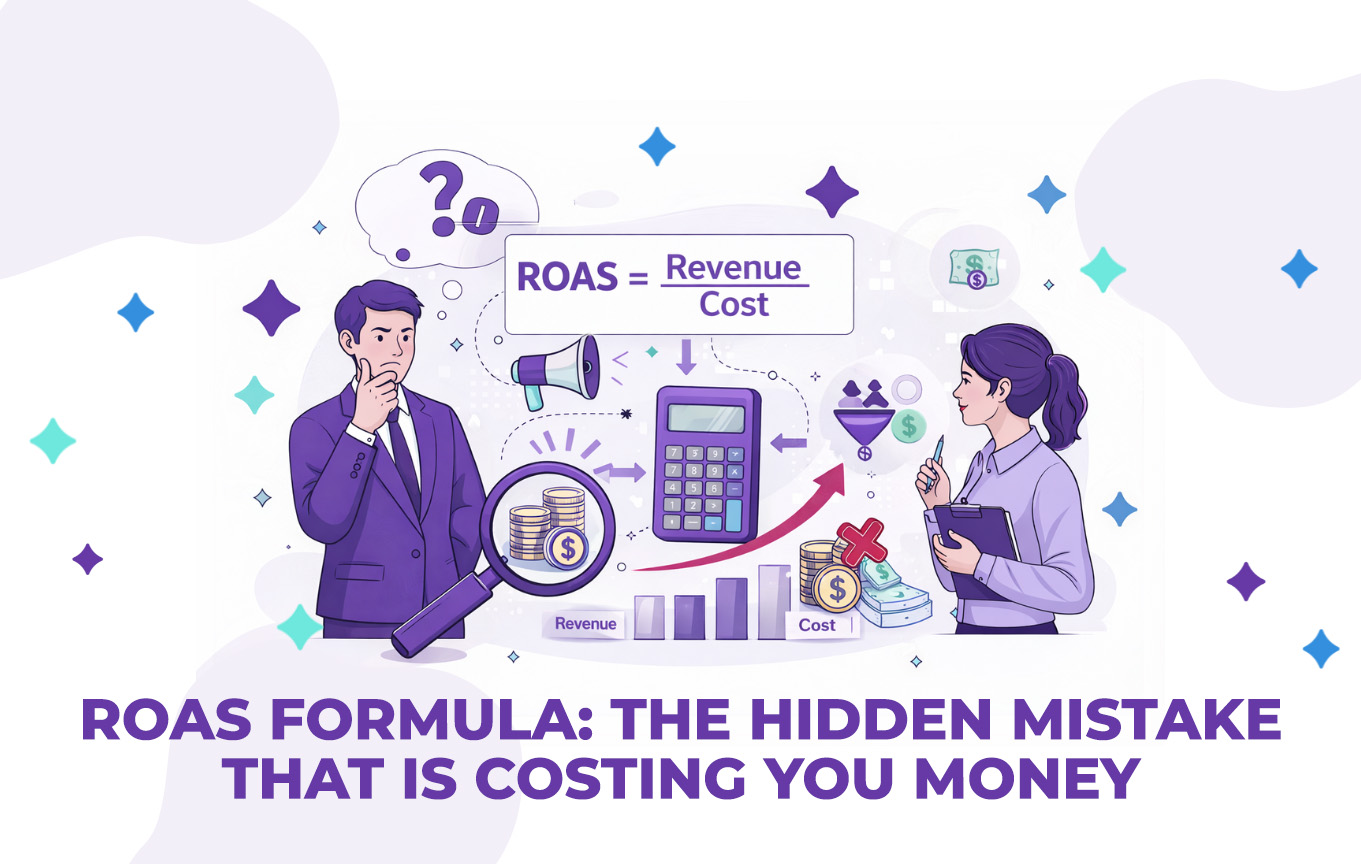
The ROAS formula is one of the most widely used metrics in paid advertising:
ROAS = Revenue generated from ads / Cost of ads
It’s simple, fast, and easy to interpret. A ROAS above 1 suggests that your ads are generating more revenue than they cost. But here lies the fundamental issue – ROAS only measures revenue, not profitability.
This means it completely ignores:
- product cost
- operational expenses
- salaries and overhead
- logistics and fulfillment
- taxes and fees
As a result, a campaign with a high ROAS can still be unprofitable in reality.
The Most Expensive Mistake Businesses Make
The biggest mistake companies make is treating ROAS as the ultimate performance indicator. Instead of analyzing full business economics, they optimize campaigns based solely on this single metric.
A typical digital marketing agency might report high ROAS as a success metric, but without understanding margins, this can be dangerously misleading. Businesses then increase budgets, scale campaigns, and push more traffic – all while unknowingly increasing their losses.
This creates a false growth loop where revenue increases, but profit decreases.
The Metrics That Actually Matter
To understand real performance, businesses need to look beyond ROAS and analyze a broader set of metrics. Advertising effectiveness cannot be reduced to one number.
Critical metrics include:
- Customer Acquisition Cost (CAC)
- Lifetime Value (LTV)
- Profit margin
- Conversion rate by channel
- Average order value
Without these indicators, ROAS becomes just a vanity metric. It shows activity, not profitability.
ROAS vs ROI: The Critical Difference
One of the most important concepts to understand is ROAS vs ROI. While these terms are often used interchangeably, they measure completely different things.
ROAS focuses on revenue generated from advertising.
ROI focuses on actual profit after all costs are considered.
This distinction is crucial. A campaign can have a high ROAS but a negative ROI if costs are too high. Businesses that focus only on ROAS risk scaling unprofitable campaigns, while those that prioritize ROI build sustainable growth.
What Most Businesses Get Wrong About ROAS
A common misunderstanding is assuming that ROAS reflects overall business success. Many marketers fail to ask the deeper question: what is ROAS actually measuring?
It measures efficiency of ad spend in generating revenue – nothing more. It does not account for customer retention, product margins, or long-term value. This limited scope is exactly why it can be dangerous when used as the primary decision-making tool.
Understanding its limitations is the first step toward making smarter marketing decisions.
The Role of Paid Advertising Platforms
Modern platforms like Google Ads and Meta Ads rely heavily on optimization algorithms. These systems learn from the data you feed them. If your primary metric is ROAS, the algorithm will optimize for revenue – not profit.
This is especially critical when working with a ppc agency, where campaign optimization is often automated. If the wrong signals are used, even advanced systems will scale inefficient campaigns.
To avoid this, businesses must align platform optimization with real financial outcomes, not just surface metrics.
Real-Life Scenarios Where ROAS Fails
There are many cases where businesses see strong ROAS performance but still lose money. For example:
- low-margin products where costs eat up revenue
- high return rates that distort actual profit
- expensive logistics that reduce margins
- aggressive discounts that inflate revenue but reduce profit
In all these cases, ROAS gives a false sense of success.
How to Fix the Problem
To avoid losing money, businesses need to shift their mindset from revenue-focused metrics to profit-focused analysis.
This includes:
- calculating net profit per campaign
- integrating CRM and financial data
- tracking customer lifetime value
- analyzing full cost structure
The goal is to build a system where decisions are based on real business performance, not just advertising outputs.
Conclusion
ROAS is a useful metric – but only when used correctly. The biggest mistake businesses make is relying on it as the primary indicator of success. This leads to scaling campaigns that generate revenue but destroy profit.
To build sustainable growth, companies must move beyond simple formulas and adopt a more comprehensive approach to analytics. Understanding the difference between revenue and profit is not just important – it’s essential.
When used wisely, ROAS can be a powerful tool. But without context, it becomes one of the most expensive mistakes in digital marketing.